Showing posts with label Symptoms. Show all posts

Thursday, November 19, 2009

Risk Factors for Malignant Mesothelioma?

What are the risk factors for malignant mesothelioma?
There are several risk factors that increase the likelihood that a person will develop mesothelioma. The primary risk factor is asbestos exposure. Exposure to this very harmful substance can significantly enhance the chances of contracting the disease. Other secondary factors include exposure to radiation, zeolite, simian virus 40 (SV40) and tobacco. We discuss each of these risk factors in more detail below.

Asbestos

Exposure to asbestos is the leading risk factor associated with mesothelioma. Asbestos is an insulating material comprised of magnesium-silicate mineral fibers. It was favored by builders and contractors for many years for its low heat conductivity and resistance to melting and burning. Since researchers have identified more and more links between mesothelioma and exposure to asbestos, the material is now less widely used. Prior to this discovery, however, millions of Americans have experienced serious exposure to this harmful substance.
Over 700,000 schools and buildings in the United States today contain asbestos insulation as reported by the US Environmental Protection Agency. Asbestos exposure doesn�t stop there, however. Asbestos is often found in ship yards, manufacturing facilities, railway facilities and construction sites. Blue collar workers are at the highest risk for developing mesothelioma due to occupational exposure and include those who work in mines, factories, shipyards, construction sites, railroads and for insulation manufacturers and gas mask manufacturers. The occupations most widely affected are miners, factory workers, railroad workers, ship builders and construction workers - especially those who install asbestos containing insulation. Sometimes family members related to the workers receive second hand exposure to asbestos from the dust and fibers that were brought home on the workers clothes and also become at risk for contracting mesothelioma.
Serpentine fibers and amphiboles are the 2 primary types of asbestos used. Chrysotile is a form of serpentine fiber and the most frequently used. These fibers tend to be curly and flexible. Amphibole fibers, however, are generally straight and thin and usually comprise one of five types: crocidolite, amosite, anthrophylite, tremolite, and actinolyte. The crocidolite type of Amphiboles is thought to be the leading contributor to cancer caused by asbestos. Serpentine fibers are dangerous as well, however, and have also been linked to mesothelioma.
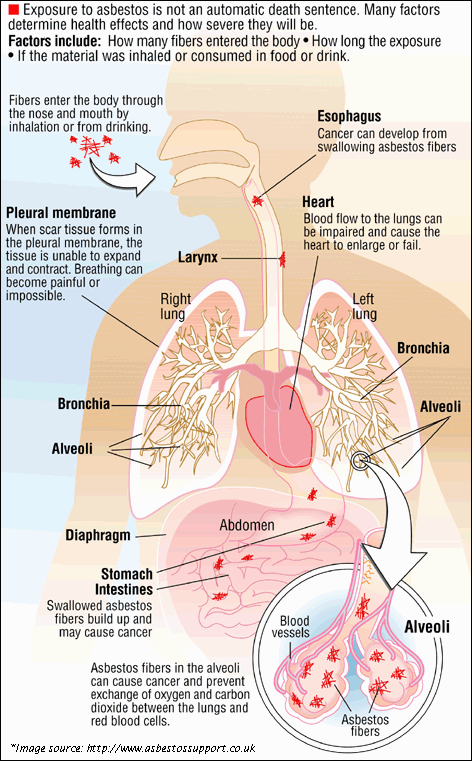
Some research points to the fact that inhaled asbestos fibers cause a physical irritation resulting in cancer rather than the cancer being caused by a reaction that is more chemical in nature. As fibers are inhaled through the mouth and nose they are cleared from the body by adhering to mucus in the nose, throat and airways and then get expelled by coughing or swallowing. The Amphibole fibers (long and thin) do not clear as easily and it is therefore thought that they can embed into the lining of the lungs and chest and result in mesothelioma.
Asbestosis (scar tissue in the lungs) or lung cancer can also be caused by the inhalation of asbestos fibers. In fact, people exposed to asbestos are seven times more likely to develop lung cancer over the general public. Workers who sustain high levels of asbestos exposure are more likely to die from asbestosis, lung cancer or mesothelioma than any other disease. It is also believed that the action of coughing up and swallowing asbestos could contribute to a form of mesothelioma originating in the abdomen called peritoneal mesothelioma. Mesothelioma has been found to exist in other organs of the body as well such as the larynx, pancreas and colon, but those instances are extremely limited compared to lung cancer incidents.
The chance of developing mesothelioma is in direct proportion to the duration and amount of asbestos exposure that an individual sustains. Those who are exposed to high levels of asbestos at a young age, for long periods of time have a greater risk of being diagnosed with mesothelioma than those who have short, low level exposure. Another important consideration is that Mesothelioma can take a long time to manifest. Often, twenty to forty years can elapse from the time of exposure to diagnosis. Genetic factors can also play a role which explains why not everyone exposed to asbestos develops and asbestos related disease.

Radiation

Thorium dioxide (Thorotrast), a substance used in x-ray tests in the past has reported links to pleural mesothelioma and peritoneal mesothelioma. The use of Thorotrast has been discontinued for many years due to this discovery.

Zeolite

Some mesothelioma cases in the Anatoli region within Turkey have been linked to Zeolite, a silica based mineral with chemical properties similar to asbestos found in the soil there.

Simian Virus 40 (SV40)

Some scientists have found the simian virus 40 (SV30) in mesothelioma cells from humans and have been able to create mesothelioma in animals with the virus. The relationship between this virus and mesothelioma is still unclear, however, and further research is being conducted to gain clarity on this potential link.

Tobacco

Smoking alone is not linked to mesothelioma, but smokers who are exposed to asbestos have a much higher chance of developing lung cancer (as much as fifty to ninety percent higher). Research indicates that lung cancer is the leading cause of death among asbestos workers.

Source : National Cancer Institute - Fact Sheets: Risk Factors and Possible Causes
http://www.cancer.gov/cancertopics/factsheet/Risk
Reblog this post [with Zemanta]

Cell Types of Mesothelioma

Malignant mesothelioma can also be classified by different cancer cell types, each of which tends to behave differently. There are three classifications assigned to mesothelioma cell types.
Epithelial Mesothelioma is the most common cell type and accounts for approximately 50-75% percent of all diagnosed cases each year. These cells are uniform in shape, with an elongated pattern that makes them easily distinguishable when viewed under high magnification. These cancers are adenocarcinomas, malignancies which are more commonly associated with pure lung cancers as opposed to cancers of the mesothelium.
Sarcomatoid mesothelioma is a less common cell type, accounting for between 7 and 20% of diagnosed cases each year. These cells grow forth out of supportive structures, such as muscles and bones.
Biphasic mesotheliomas are those with a mix of epithelial and sarcomatoid cell types. Treatment options do not vary greatly between cell types, but often sarcomatoid mesotheliomas are more difficult to treat as a result of the surrounding affected tissues from which they spread.
Thoracoscopy and the use of special stains can be helpful in identifying cellular classifications, though obtaining adequate tissue samples often require more invasive surgeries.
Source : Mesothelioma


Reblog this post [with Zemanta]

Wednesday, November 18, 2009

Exposure of Asbestos

1. What is asbestos?
�Asbestos� is the name given to a group of minerals that occur naturally as bundles of fibers which can be separated into thin threads. These fibers are not affected by heat or chemicals and do not conduct electricity. For these reasons, asbestos has been widely used in many industries. Four types of asbestos have been used commercially:
* Chrysotile, or white asbestos;
* Crocidolite, or blue asbestos;
* Amosite, which usually has brown fibers; and
* Anthophyllite, which usually has gray fibers.

Chrysotile asbestos, with its curly fibers, is in the serpentine family of minerals. The other types of asbestos, which all have rod-like fibers, are known as amphiboles.
Asbestos fiber masses tend to break easily into a dust composed of tiny particles that can float in the air and stick to clothes. The fibers may be easily inhaled or swallowed and can cause serious health problems.
2. How is asbestos used?
Asbestos was mined and used commercially in North America beginning in the late 1800s. Its use increased greatly during World War II. Since then, it has been used in many industries. For example, the building and construction industry has used it for strengthening cement and plastics as well as for insulation, fireproofing, and sound absorption. The shipbuilding industry has used asbestos to insulate boilers, steampipes, and hot water pipes. The automotive industry uses asbestos in vehicle brakeshoes and clutch pads. More than 5,000 products contain or

What is Asbestosis ?

Asbestosis is a progressive and irreversible lung condition that typically leads to subsequent respiratory disability. Please click on the following links to find out more about the asbestos lung condition Asbestosis.
Asbestosis is a lung condition, often referred to as a �diffuse pulmonary fibrosis� which results from the inhalation of asbestos fibers. It is one of a number of diseases categorized as occupational lung disease or environmental lung disease. A unique aspect of asbestosis that distinguishes it from other fibrotic diseases (such as silicosis) is the presence of asbestos bodies and fibers in the lung tissue. Additionally, asbestos bodies and fibers have been detected in small numbers beyond the lung: in tonsils, thoracic and abdominal lymph nodes, pleura, peritoneum, liver, spleen, pancreas, kidneys, small and large intestines, esophagus and stomach.
How Did I Get Asbestosis?
Asbestos exposure results from people inhaling fibers that are in the air when they breathe. The people with the heaviest risk of exposure to asbestos are those who work directly with the mineral, whether is mining or processing it, during production of asbestos-containing products, or during installation of asbestos insulation.
Family members of asbestos workers are also at risk of inhaling high doses of asbestos fibers. Every member of the household can become exposed to asbestos by coming in contact with and inhaling asbestos fibers that are unknowingly carried home from work on their family member�s clothing.
Exposure to building materials that contain asbestos, specifically in older building is also a concern. If over a period of time insulation material, floor or ceiling tiles start to decompose, asbestos fibers can become airborne and may pose a serious health threat. In this type of situation, asbestos fibers tend to create a dust composed of tiny particles that can float in the air. However, as long as the material is not damaged or disturbed, such as remodeling or drilling, then the asbestos fibers will not be release into the air and therefore will not pose a threat to human health.
Asbestos contamination can also result from ingesting contaminated food or liquids. It can also be detected in the water supply as well as in the air. Asbestos may be released into the water through erosion or natural deposits, corrosion from asbestos-cement pipes, and disintegration of roofing materials containing asbestos that are then transported into the sewers.
What Are The Clinical Signs Of Asbestosis?
Clinical presentation of this disease may include the following:
* Shortness of breath (dyspnea)
-rarely occurs before a decade of exposure
-appears first only upon exertion and subsequently occurs at rest
* Dry cough
-dry and troublesome cough, perhaps associated with chest pain
* X-Ray changes
-generally beginning with irregular opacities at the bases of the lungs, perhaps extending into the upper zones gradually
* Pulmonary function deficiencies
-typically a pulmonary function test reveals a restrictive lung disease pattern
-there may be a pulmonary function loss before x-ray changes become evident
Other more advanced symptoms of this disease include clubbing of the fingers (increased thickness of the digits and curvature of the nails) and cor pulmonale. Medical monitoring for radiologic changes is key, as persons with asbestosis have an increased risk of developing a malignancy.
By : Mirg

Tuesday, November 17, 2009

Asbestos Cancer

A prominent mineral asbestos greatly in many modern manufacturing business. It is agreed that the ore is used for building and all kinds of other projects. Ore were also become a health hazard. The cause of the cancer asbestos cancer or entry. This is a delicate situation, many industries are not understanding the harmful effects of asbestos. When the employee development, they asbestos cancer for legal proceedings. These litigation ran into millions, in order to prevent possible circumstances, the company has to invest for its employees appropriate protective equipment with asbestos work.
Every inch of the human body is composed of cells. These cells are copying the replay. This kind of cell replication occurred in the process of the main share. As long as cell replication process control, human organs, including will resume normal function. When a cell replication, so it becomes abnormal condition called to cancer. Since mesothelioma is irregular growth by cells in the area of cells, causing the asbestos cancer mesothelioma. This factor, the abnormal growth of cells is still mysterious. mesothelioma
Have certain differences between cancer and other normal mesothelioma cancer. Since mesothelioma can find covering almost all major organs such as the heart, lungs and cancer of the body can be. Secondly, it is difficult to diagnose this type of cancer. Employees complain about physical pain, but family members work related fatigue, ignore it and fatigue. It is in the final stages, that her cancer patients with the entry. You may already know this fact � this is a threshold, patients must undergo treatment during the procedure.meso-info.net
Once this period is gone, the patient�s cancer may not respond to your treatment. Allegedly, fine powder, inhaled asbestos, will lead to cancer mesothelioma. The importance of this layer can never be underestimated. The protective layer is known and protect its regular lubrication authority from the influence and suddenly. This form of treatment of cancer, but only a small percentage popularization of treatment by the reaction of success.
Adhere to effective protective measures, one is with asbestos. Cancer may affect a person, smoking, he may not know it. The employee training about the disease, for they provide sufficient information is the first step, by our company in order to eliminate to this situation. It is discouraging to find even many employers know the situation, cancer progression in our country entry. Many people, because life is at stake in this condition and employers seem to ignore the situation.
By : Meso Info

Asbestos and Mesothelioma Cancer

Smoking is a form of cancer in film (called mesothelium), lung, chest, abdomen lining, sometimes torn. Although rare, mesothelioma symptoms strike over 200 people each year in the United States. Most cases is directly linked to entry asbestos exposure.
Due to long-term incubation period of the average age of the patients in the entry of 50-70 years old. Most people because of smoking affects one in industry contacts asbestine high print. Mesothelioma symptoms include respiratory problems, shortness of breath, cough and pneumonia. Other mesothelioma symptoms including abdominal swelling, and weight. In some mesothelioma symptoms mesothelioma is quite low, patient, make it difficult to mesothelioma doctors diagnose.
The doctor specializes in research and treatment, the entry of mesothelioma of cancer.
Mesothelioma (or cancer mesothelium) is a kind of disease, deformity, no control cell replication. These cells in mesothelioma invasion and damage tissues and organs. Mesothelioma cancer cells to spread to internal body, causing the leading cause of death.
Treatment mesothelioma clinical trials, test and smoking
There are many mesothelioma treatments. Treatment includes surgery, radiotherapy and chemotherapy and mesothelioma treatments depends on the patient�s age, health and the stage of cancer. There has been much mesothelioma research in the past two years to find new treatments. Click here to find out more about mesothelioma processing technology.
Through the study, the national cancer institute entry test and clinical trials � mesothelioma is to find new treatments. Because of the increasing number of cases in the United States, the two countries mesothelioma government-sponsored research mesothelioma increase. Mesothelioma research and clinical trials are successful in developing new technology to fight cancer and prospects of more advanced treatment mesothelioma is bright.
Surgical treatment is one of the most common malignant mesothelioma. Organization and lining by mesothelioma is doctor, may also include pulmonary even the diaphragm.
Another method is to use radiation therapy mesothelioma higher-energy x-rays, kill cancer cells. Radiation can in the body.
The third mesothelioma chemotherapy treatment. Through the tablets or drugs through the needle, chemotherapy drugs are used to kill cancer cells.
A new method called mesothelioma treatments photodynamic therapy. In this treatment, light and drugs are used to kill cancer cells in the early surgery mesothelioma chest. Although there are many treatment and drug treatment, doctors have mesothelioma lost against this fatal disease. Most mesothelioma treatments involve ancient technology, combined with different drug cocktails. However, in most cases, these mesothelioma treatments has many side effects including organ damage, nausea, increase in heart failure, etc. In order to find a more effective treatment or therapy in numerous mesothelioma is clinical trials are throughout the country. We hope that one day will erradicate mesothelioma treatments mesothelioma cancer and asbestosis.
By : Mesoinfo

The History of Mesothelioma

Smoking is a rare type of cancer, has been proved to be caused by almost always inhaled asbestos particles. Mesothelioma browbeating, usually in a man�s body spread quickly once it�s development. Therefore, when it was found in a man�s body, it usually spread and positive intruder vital organs and tissue in other areas � � may be in just a few months. Treatment of patients, general won�t face entry of a very active long-term prognosis.
Mesothelioma appeared in the form of cancer. Tumor will appear in any place, or in any organ, have mesothelium coverage. Sometimes in tumor detection, determined to be benign, or explanation. This tumor is usually treated explanation, but not in the same way as cancerous.
If a person has to expose tumors or inhaled Mesothelioma of asbestos particles at any time, and in their lives, or will be, malignant cancer. The only certain way to decide whether it is benign or malignant Mesothelioma is a biopsy.
Once a malignant Mesothelioma tumor was detected, testing and determination are malignant, other malignant tumors may appear in other organs. This type of �the dissemination�, refers to the tumor metastasis. If pleural Mesothelioma is found in the tumor may, for example, began to appear on the other place than the original site. There is no way to determine which organs in tumor will pop up after the initial diagnosis.
There are several types of malignant mesothelioma, but they are three of the most common. The most common of these three called �epithelium.� Fortunately, the epithelium, is a form of optimal therapeutic mesothelioma responds to. All three types of general are treated equally surgery, radiotherapy and chemotherapy.
In most cases, the malignant Mesothelioma was found in a man�s chest. The second most common cancer diagnosis of local exist when the belly. The most common place was found in the original tumor, that is in the heart.
When the tumor, they are called �in the chest and rib Mesotheliomas� when they found in the abdomen, they are called �, and �Mesotheliomas peritoneal when they found in the heart, they are called�, the pericardial Mesotheliomas.�
This mesothelium is covered inside (two layers, and allow them to sit organs to other organs and tissue without friction or causing friction and influence each other mutually. In other words, the outer membrane provide mesothelium organs and lubricating fluid, so that they can each side sliding. The heart and lungs, for example, and constantly expand and contract, and mesothelium allow these organs without any kinds of moving membrane friction.
According to the position, or organ, it is mesothelium around, it is to point to by different names. When mesothelium mentioned throughout the country, in a person�s abdominal organs, mesothelium called �, peritoneal.� This mesothelium coverage in the chest organs or lung pleural cried, �yes�. Mesothelium membrane cover heart is called �package�.
When a man began to develop, mesothelium Mesothelioma tumor growth. Tumor formation and peritoneal pleural, and/or mesothelium pericardium. When the tumor formation, this is a signal that these cells differentiate the mesothelium control and the normal order of them. Once you begin, it usually cancer has spread to the rest of the body mesothelium area, it also can be transferred to the surrounding tissues and organs.

Treatment and Symptoms of Mesothelioma

Mesothelioma is considered as the most deadly type of cancer caused by inhaling asbestos particles floating in the air. Most of the people who directly or sometimes indirectly exposed to asbestos contact this disease. This affects the mesothelium which is a protective layer of most internal organs in the body. Develop malignant cells in the mesothelium of heart, lungs or stomach. The mesothelium of the chest cavity and lungs is known as the pleura, the lining of the stomach called the peritoneum, and pericardium is the lining of the heart. There are provisions in the law for compensation Mesothelioma patients and special attorney called asbestos lawyers assist patients in their legal pursuit.


Mesothelioma Symptoms
Mesothelioma Symptoms occur in the last stage of curing so that becomes very difficult. Symptoms can be seen after long exposure to asbestos that may be a long gap of twenty to fifty years. The main symptom is shortness of breath due to accumulation of fluid in the chest, cough, pain in the chest; blood may also appear with a cough or spit. These symptoms can be seen if the pleura or pericardium affected. If the peritoneum is affected patients will develop a loss of appetite, abdominal pain, weight loss, intestinal problems, anemia and fatigue. Patients may also suffer from frequent fevers.


Treatment of Mesothelioma
Effective treatment of this disease depends on several factors such as where the cancer stage has been detected, what is the age of the patient, how many cancer cells has been circulated and the general health condition of patients, that is, whether he is suffering from another disease or not. Have observed that chemotherapy is the only treatment available for these patients. Use of drugs, chemicals or drugs in a systematic way to eradicate cancer cells. The drug is injected either directly in the body or given in pill form.
Other forms of immunotherapy treatment, surgery and radiation in which malignant cells are destroyed so they do not spread to other parts of the body. In severe cases of many tumors can be detected in the affected area for the first of these doctors surgically remove the tumor and then the forms of treatment to follow.
The patient must decide whether he will undergo a painful treatment or persist for six to twelve months without treatment.

By Robby Morton

Monday, November 16, 2009

Symptoms of Mesothelioma


Symptoms of mesothelioma may not appear until 20 to 50 years after exposure to asbestos. Shortness of breath, cough, and pain in the chest due to an accumulation of fluid in the pleural space are often symptoms of pleural mesothelioma.


Symptoms of peritoneal mesothelioma include weight loss and cachexia, abdominal swelling and pain due to ascites (a buildup of fluid in the abdominal cavity). Other symptoms of peritoneal mesothelioma may include bowel obstruction, blood clotting abnormalities, anemia, and fever. If the cancer has spread beyond the mesothelium to other parts of the body, symptoms may include pain, trouble swallowing, or swelling of the neck or face.
These symptoms may be caused by mesothelioma or by other, less serious conditions.
Mesothelioma that affects the pleura can cause these signs and symptoms:
* chest wall pain
* pleural effusion, or fluid surrounding the lung
* shortness of breath
* fatigue or anemia
* wheezing, hoarseness, or cough
* blood in the sputum (fluid) coughed up
In severe cases, the person may have many tumor masses. The individual may develop a pneumothorax, or collapse of the lung. The disease may metastasize, or spread, to other parts of the body.
Tumors that affect the abdominal cavity often do not cause symptoms until they are at a late stage. Symptoms include:
* abdominal pain
* ascites, or an abnormal buildup of fluid in the abdomen
* a mass in the abdomen
* problems with bowel function
* weight loss
In severe cases of the disease, the following signs and symptoms may be present:
* blood clots in the veins, which may cause thrombophlebitis
* disseminated intravascular coagulation, a disorder causing severe bleeding in many body organs
* jaundice, or yellowing of the eyes and skin
* low blood sugar level
* pleural effusion
* pulmonary emboli, or blood clots in the arteries of the lungs
* severe ascites
A mesothelioma does not usually spread to the bone, brain, or adrenal glands. Pleural tumors are usually found only on one side of the lungs.